


How Small Businesses Can “Spy” Their Way Into Better Local Rankings
Here’s where almost everyone gets it wrong.
They start by obsessing over tools, hacks, or some magical focus keyword the latest blog post told them to chase.
Forget that for a minute.
If you want to understand what Google thinks is “good” for your type of business in your slice of Western Mass, you start by searching the way your customers do. This is the foundation of WordPress SEO in Western Massachusetts, not tricks or tools, just seeing what Google already rewards in your market.
If you’re a plumber, you’re not typing “plumbing SEO strategy 2026” into Google. You’re typing “plumber near me,” “emergency plumber,” “water heater repair,” “drain cleaning,” and maybe the name of the town. If you’re an attorney, maybe it’s “estate planning lawyer,” “small business attorney,” “family law firm,” plus your area. Jeweler, therapist, life coach, roofer, bookkeeper, financial advisor, same idea. You think in problems and services, not buzzwords.
So here’s your first spy assignment. Pick a handful of phrases a real person would use to find you. Run those searches as if you’d never heard of your own business. Then pay attention to who keeps showing up in the map pack and in the regular search results, over and over again. Those are the players Google already trusts in your market.
Congratulations. You’ve just identified your “persons of interest.”
Meet the map pack: the tiny box that decides who gets seen
When you punch those searches into Google, you’ll notice something. You don’t just get a list of blue links anymore. You get a little surveillance screen at the top of the page: a map with a handful of business names underneath it. That box is the map pack, and it’s where a lot of the action happens, especially when you’re working on WordPress SEO in Western Massachusetts and trying to show up for real local searches.
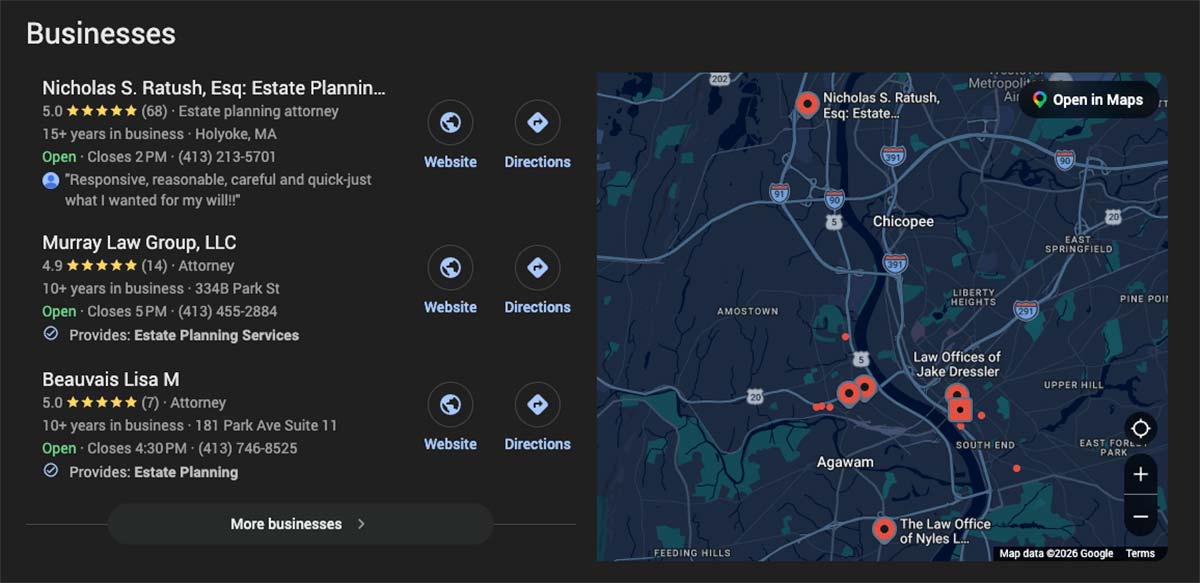
Sometimes you’ll see a sponsored listing at the top of that box. Somebody paid for that stakeout position. Under that ad, you usually see three local businesses. You get their name, some stars, a couple of lines about what they do, and maybe where they’re located. To see anyone else, you have to click “More places” and go digging down the alley.
In real life, almost nobody clicks “More places.” If you’re not in those top three local spots for searches that actually matter to your business, you might as well be hiding behind a dumpster in the dark. You’re not “a little lower.” You’re invisible in that moment.
Now, a few people do keep scrolling. When they scroll past the map pack, they hit the regular organic results. That’s your second window. If you’re not in the map pack yet, you at least want to be one of the first regular links people see when they keep going. When a business shows up in the map pack and near the top of those organic links at the same time, that’s somebody Google really likes for that search, a prime suspect worth tailing.
One more thing for your dossier. As you do this, you’ll see some national or multi‑location brands pop up. If you’re a local plumber, you do not need to model your site after Roto‑Rooter. If you’re a local law firm, you don’t need to copy some enormous national franchise. They’re running a different operation with different budgets, different link profiles, and in some cases entire teams dedicated to SEO.
Your mission is to watch the locals who look and feel more like you but keep outranking you. That’s where the useful intelligence is.
 How to reverse‑engineer what the top locals are doing
Once you’ve got your list of usual suspects, it’s time to click through and actually snoop.
You’re not clicking as a jealous competitor. You’re clicking as a detective with a notepad, peeking through the blinds. You want to know what these sites are actually doing that you’re not.
Start at the top and ask yourself a few simple questions.
What does their site have that mine doesn’t? What’s hiding in plain sight on their pages that’s missing from mine?
Do they have one vague “Services” page, or do they break their work into separate pages that each talk about one real‑world thing? If they’re a plumber, do they have individual pages for water heaters, drain cleaning, emergency calls, bathroom remodels? If they’re an attorney, do they separate estate planning, business law, family law, criminal defense?
How clearly do they talk about where they work? Is “we serve Western Mass” buried in one sentence, or do they actually name the towns and areas people recognize? Springfield, Chicopee, Amherst, Easthampton, Pittsfield, the Hilltowns, do those names show up in headings and normal sentences, the way a real local talks?
What questions are they answering that you hear from your clients all the time, but have never bothered to put on your own site? Do they explain timelines, pricing ranges, what happens first, what happens next, what could go wrong? Or are they just throwing pretty words at the wall?
You don’t need any special software to see this. It’s all sitting right there on their pages, out in the open. Once you’ve looked at three or four of the top local sites in your niche, you’ll start to see patterns.
Those patterns are what actually drive WordPress SEO in Western Massachusetts, not guesswork, not plugins, but what’s already working in your backyard. The way your WordPress site is structured, how pages are organized, and how clearly you explain your services all play into that.
Google is basically whispering, “When someone around here searches for this kind of business, this is the kind of site we like to show them.”
Your job is not to photocopy those sites. Your job is to treat them as the floor. If that’s what “good enough to rank” looks like, then the real question is: how do you use your WordPress site to hit that floor and then raise it? Clearer structure. Better explanations. More honest content that sounds like you talking to a human being, not you muttering buzzwords into a wiretap.
 What your SEO plugin is really doing in the background
Now let’s talk about the part of the operation where a lot of business owners get hypnotized: the plugins.
On WordPress, three names come up again and again: Yoast, Rank Math, and All in One SEO. They all give you the obvious stuff, titles, meta descriptions, and those little red‑yellow‑green indicators tied to a “focus keyword.” But behind the scenes, they’re also quietly handling some important housekeeping for your cover story.
They generate XML sitemaps, machine‑readable maps of your site that help search engines find your important pages and keep up as you add or remove content. They let you decide which content types show up in that sitemap (posts, pages, categories, tags, sometimes products or other custom types) and which ones stay out of it. They give you global settings for things like whether a whole type of content should be indexable in the first place, what your default titles look like, and how your brand name appears in search results.
If you’re using something like Rank Math Pro, you also get schema tools, ways to tell Google, “This is a local business,” “This is a service page,” “This is an article,” in a structured, behind‑the‑scenes format. Rank Math can add local business schema for you when you turn on its Local SEO module, and it can apply templates for different schema types across your site. All in One SEO and Yoast have their own schema features and let you control things globally as well.
You do not have to become a schema engineer today, but it matters to know that your plugin isn’t just scoring your headlines. It’s helping search engines crawl your site, decide which URLs to pay attention to, and understand what kind of pages they’re looking at. There’s an entire in‑depth article waiting to be written about local business schema, service page schema, and article schema for Western Mass businesses; for now, you just need to know your plugin can help with that part when you’re ready.
So yes, use the plugin. Let it remind you to fill in your titles and descriptions. Let it manage your sitemap and basic schema defaults so you’re not hand‑coding anything at midnight. But don’t mistake the control panel for the mission. The real strategy is still you deciding what needs to be on each page so the people you want to work with actually understand what you do.
 One page, many angles: a simple real‑world setup
Here’s how this looks when you’re back in the field.
Imagine you’re that single‑location insurance agent serving a few towns in Western Mass. You don’t have the time or budget right now to build twenty individual pages for every kind of vehicle coverage. You just want the site to pull its weight without turning into a second job.
So maybe we build one solid “Auto & Vehicle Insurance” page. On that page, we make it very clear that you write personal auto policies. We also spell out that you cover motorcycles, RVs, ATVs, and boats. We talk about the things people here actually bring up: winter driving, kids getting their licenses, parking in the snow, towing, taking the RV down the coast for a week.
Your plugin might be fixated on “auto insurance” as the focus phrase. That’s fine. The content is doing more than the plugin can see. It’s catching related searches in a way that still reads like a real conversation, not a pile of keywords stitched together in a back room.
Down the road, if boat insurance becomes a big part of your revenue, maybe that gets its own page. That’s easy to do on WordPress. The point is, you’re structuring things to match the reality of your business as it is today, not to satisfy a checklist that has never answered your phone or sat across the desk from your clients.
The tool rabbit hole (and why you don’t have to live in it)
If you’ve spent any time Googling SEO, you’ve seen the logos: Ahrefs, SEMrush, BrightLocal, Whitespark, and a half‑dozen others. The serious‑sounding tools the pros use when they’re running a full surveillance operation.
They’re real. They’re powerful. Agencies use them when they’re doing deep‑dive SEO work and content planning for clients who are ready to treat search as an ongoing channel.
But if you’re running a local business in Western Massachusetts and trying to keep your team moving, here’s the honest version:
You probably do not need to live inside those dashboards to see meaningful improvement. Not at this stage.
What you need first is a site that isn’t sabotaging you from the shadows.
A WordPress site that loads quickly enough that people don’t bail. One that doesn’t fall apart on a phone. One with clear page titles, headings that make sense, and internal links that help people move between related content instead of leaving them in a dead‑end hallway.
You need pages that talk about what you actually do in language your customers actually use. You need a Google Business Profile that is claimed, filled out, and not ignored. You need to show up in a handful of places that still matter, your local chamber, a couple of relevant directories, review sites where people actually look you up when they’re checking you out.
Do that, and your spy work starts to pay off. Suddenly you’re not invisible. You start seeing your name in more searches. You start getting calls and emails from people who did not already know you, because you finally gave Google something solid to point them to.
Bringing it all together for Western Mass
So let’s pull the case file together.
WordPress SEO for a Western Massachusetts small business is not about memorizing every Google update or buying every tool under the sun. It’s about three things: paying attention, telling the truth clearly, and giving search engines a few obvious reasons to trust you.
You put on your spy hat and search like your customers. You stop staring at your own site and start watching who consistently shows up in the map pack and the organic results for the phrases that matter in your niche. You ignore the giant national outfits and focus on the local businesses that feel like you but rank ahead of you.
You study what their sites actually do: how they structure their services, how they talk about locations, how much real information they give away. Then you go back to your own WordPress site and you start closing those gaps, in your own voice, with your own story, for your own part of Western Mass.
You let the SEO plugin handle the boring but important stuff, sitemaps, global settings, basic schema, the green‑light nudges, while you stay focused on the pages and words humans actually see. You clean up the technical foundations so your site loads and works the way it should. You claim your local profiles and get your business information consistent wherever it appears.
You don’t have to be perfect. You just have to be a little less mysterious to both Google and the people who are already out there searching for you.
When you look at your own site through that lens, spy hat on, map pack in mind, where does it feel weakest right now: the words and structure on your pages, the way you’ve set up your SEO plugin and sitemap, or how visible you are in local places like Google Business Profile and directories?
When you’re ready to stop guessing and start seeing exactly what Google sees, that’s where Cider House steps in, we put our spy gear on for you, running deep technical SEO audits, tightening up your WordPress setup, and dialing in local SEO so your business shows up where it should in Western Mass. From cleaning up crawl issues and fixing what’s quietly breaking your rankings, to building out service pages, local signals, and sane schema with the right plugins, we turn your site from “nice to have” into an asset that actually sends you leads. If you’re curious where you stand right now, the next move is simple: reach out, and we’ll tell you, in plain English, what’s working, what’s leaking, and what it would take to close the gap.
