


SEO for Plumbers: The Plumber SEO Guide to Rank Higher and Get More Calls
You don’t need more traffic. You need the homeowner who just searched for a plumber and is ready to book. That’s the whole point of plumber SEO. When someone nearby goes looking for help, you want them landing on you, not the shop across town.
This one’s written for plumbers and the people running plumbing shops who are tired of leaving their lead flow to chance. We’ll get into how people actually search for a plumber, and how to do the keyword research that finds those phrases. How to set up your website so it ranks. Local SEO and your Google Business Profile. Backlinks, the technical basics, the tools that help, and the honest question of when it’s worth hiring a plumber SEO company instead of grinding it out yourself.

What Is Plumber SEO (Search Engine Optimization for Plumbers)?
Plumber SEO just means setting up your website and your local listings so you show up when someone nearby searches for a plumber. Someone types “emergency plumber near me” at 11 p.m. Or “drain cleaning in [city]” on a Saturday morning with coffee going cold. If your site and your Google listing are in decent shape, you’re sitting near the top when they look. That’s when the phone rings.
A few pieces go into it. On-page SEO covers what lives on your pages. Off-page SEO is your reputation out across the rest of the web, mostly through backlinks. The technical side keeps everything fast and easy to crawl. Local SEO ties all of it to the towns you serve. Get those working together and you start showing up often enough that homeowners know your name before they even need you. That recognition is what earns the first call instead of the third.
Most of this traces back to how your site is built. When the structure is clean, Google understands what each page is about, and a homeowner who’s stressed and in a hurry can find the call button without hunting for it. Bad structure hurts both at once.
At Cider House Media, we’ve been building websites and helping local businesses compete online for more than a decade. We’ve seen firsthand that SEO and web design can’t really be separated. Getting found matters, but once someone lands on your site, it still has to earn their trust and make it easy to take the next step.
How plumber SEO helps people searching for a plumber find you
Picture a homeowner watching water creep across the kitchen floor. Or standing in a cold shower because the water heater quit overnight. They aren’t Googling “marketing trends.” They’re typing “emergency plumber [city]” or “burst pipe repair near me” with wet socks on. What they want is a straight answer and a number to call, right now.
When your SEO is dialed in, your site and your Google listing are right there in that moment. No waiting for them to remember the magnet on the fridge or catch your van at a red light. You’re in front of them the second they’ve decided to hire someone.
Plumber SEO vs. generic SEO for local businesses
Generic local SEO treats a plumber like a coffee shop. It isn’t the same business. A coffee shop wants steady foot traffic all day. You want the one person whose basement is filling up. Plumbing runs on urgency and same-day searches, and most people only start looking once something is already leaking or backed up. That changes what you optimize for.
So plumber SEO leans hard on service keywords, emergency intent, and the towns you actually cover. You’re not chasing vanity traffic. You want the searches that end in a booked job. Drain cleaning. Water heater replacement. A sewer line that needs attention before Thanksgiving. Those bring paying customers, not random clicks from three states away.
Why SEO Matters for Your Plumbing Business
Most plumbing companies run on referrals and repeat customers, with some paid ads filling the gaps. That works, but it swings. A slow month for referrals is just a slow month. SEO gives you a third leg to stand on: people who find you through search on their own, whether or not the phone happened to ring that week.
Get the site right and get your local SEO strong, and you can hold the top spots for the searches that matter in your market. More of those searches turn into calls and form fills. And a good share arrive as emergencies, which tend to close fast and pay well.
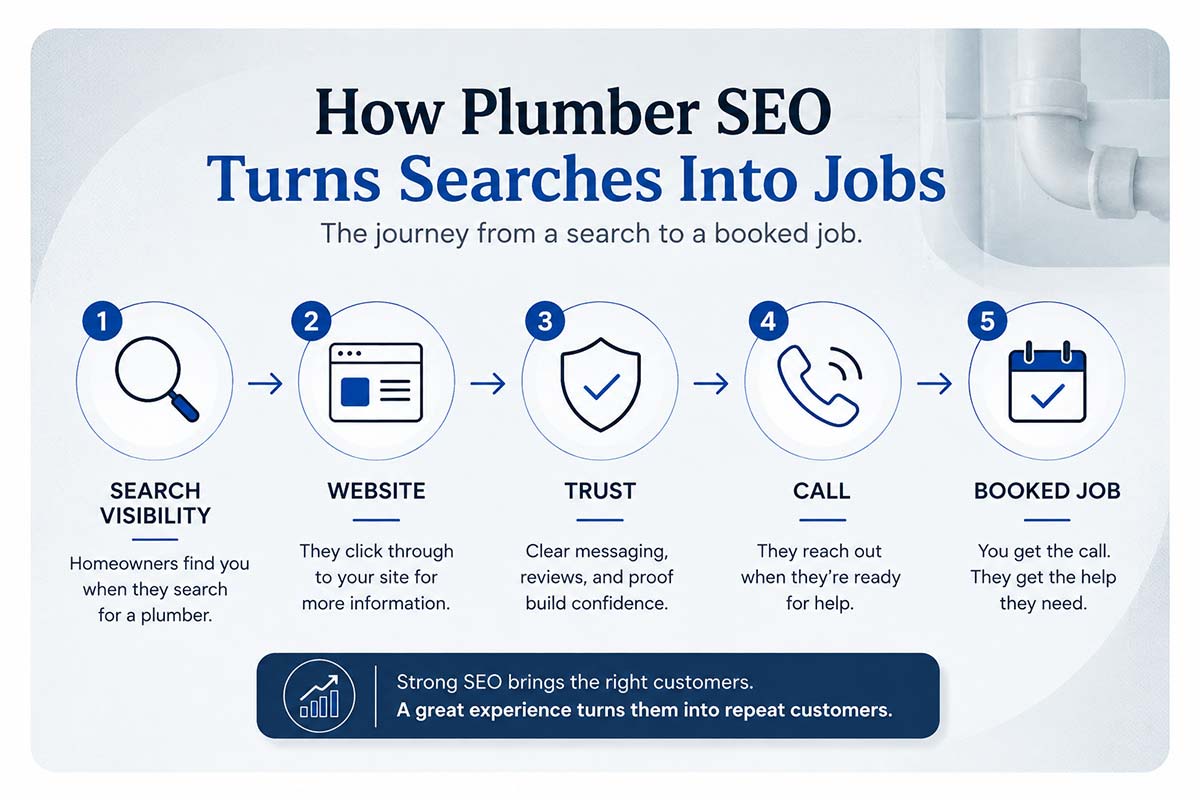
Plumber SEO is about more than rankings. Search visibility gets the right homeowner to your website, while a strong website and clear trust signals help turn that search into a call and a booked job.
From chasing ads to inbound leads with plumber SEO
Ask anyone on your crew which feels better. Burning budget on clicks that may or may not turn into anything. Or picking up a call from someone who just searched “emergency plumber near me” and chose you off the first page. Plumber SEO is about stacking more of that second kind into every day.
Plenty of shops keep the pipeline full with Local Services Ads and Google Ads. Nothing wrong with that. But ads stop the second you stop paying. SEO is different. It keeps producing calls in the gaps between campaigns, and it builds on itself over time instead of resetting to zero. Referrals, repeat work, ads, and search leads all feeding the schedule together. That’s how a plumbing business grows without living or dying by the ad budget.
How ranking at the top of search results grows your plumbing company
Most homeowners never scroll past the first few results. Rank near the top for “plumber [city]” or “emergency plumber [city]” and you simply get more at-bats. Emergencies raise the stakes even higher. When the basement is filling up, nobody’s comparison shopping. The first company that looks trustworthy usually gets the call.
The more content you add and the more you tighten things up, the wider your net gets. You start catching searches for drain cleaning, water heater repair, sewer trouble, and the hundred small questions homeowners type before they ever call. Every one of those is a door into your business that costs you nothing in ad spend.
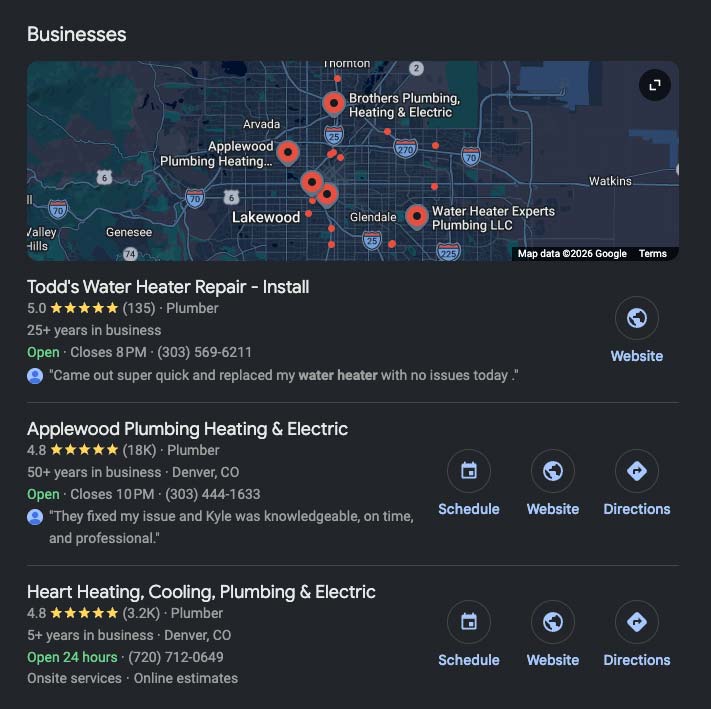
Search intent matters. A search for “plumber Denver CO” produces this set of local plumbing companies.
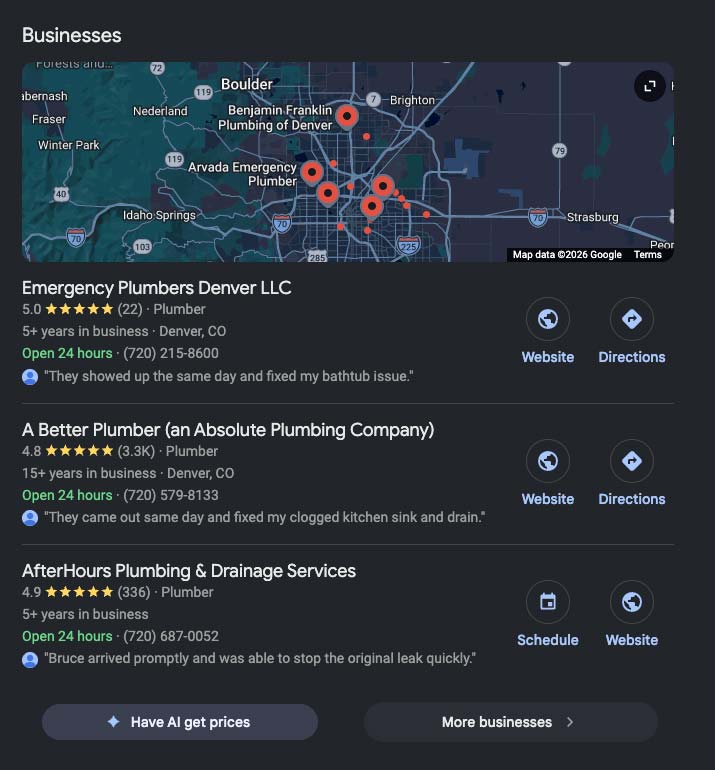
Change the search to “emergency plumber Denver CO,” and Google returns a different group of businesses—showing why targeting the right plumbing keywords matters.
Plumber SEO Keyword Strategy: How People Search for a Plumber
Keywords come first. The job is to match the phrases people actually type when they need a plumber to the pages sitting on your site. Chase the wrong ones and it won’t matter how sharp the design is. The right people still won’t find you.
Four kinds of searches matter here:
- Service terms, like drain cleaning, water heater repair, or sewer line repair
- Location terms, like your city names, “near me,” and “local plumber”
- Emergency terms, like emergency plumber, 24 hour plumber, or burst pipe
- Questions, like why a drain runs slow or what a water heater replacement costs
Finding plumbing keywords your customers actually use
Start with a plain list of what you do. Drain cleaning, water heaters, leak detection, fixture installs, sewer repair, repiping, gas lines. Add commercial plumbing if you take it. Then ask one thing about each: how would a homeowner in a hurry actually type this into Google?
You’ll get phrases like “emergency plumber near me,” “water heater repair [city],” and “clogged drain [city].” Toss in a few broader ones like “best plumber in [city].” That list becomes your map. It tells you which page on your site should be built to rank for which search.
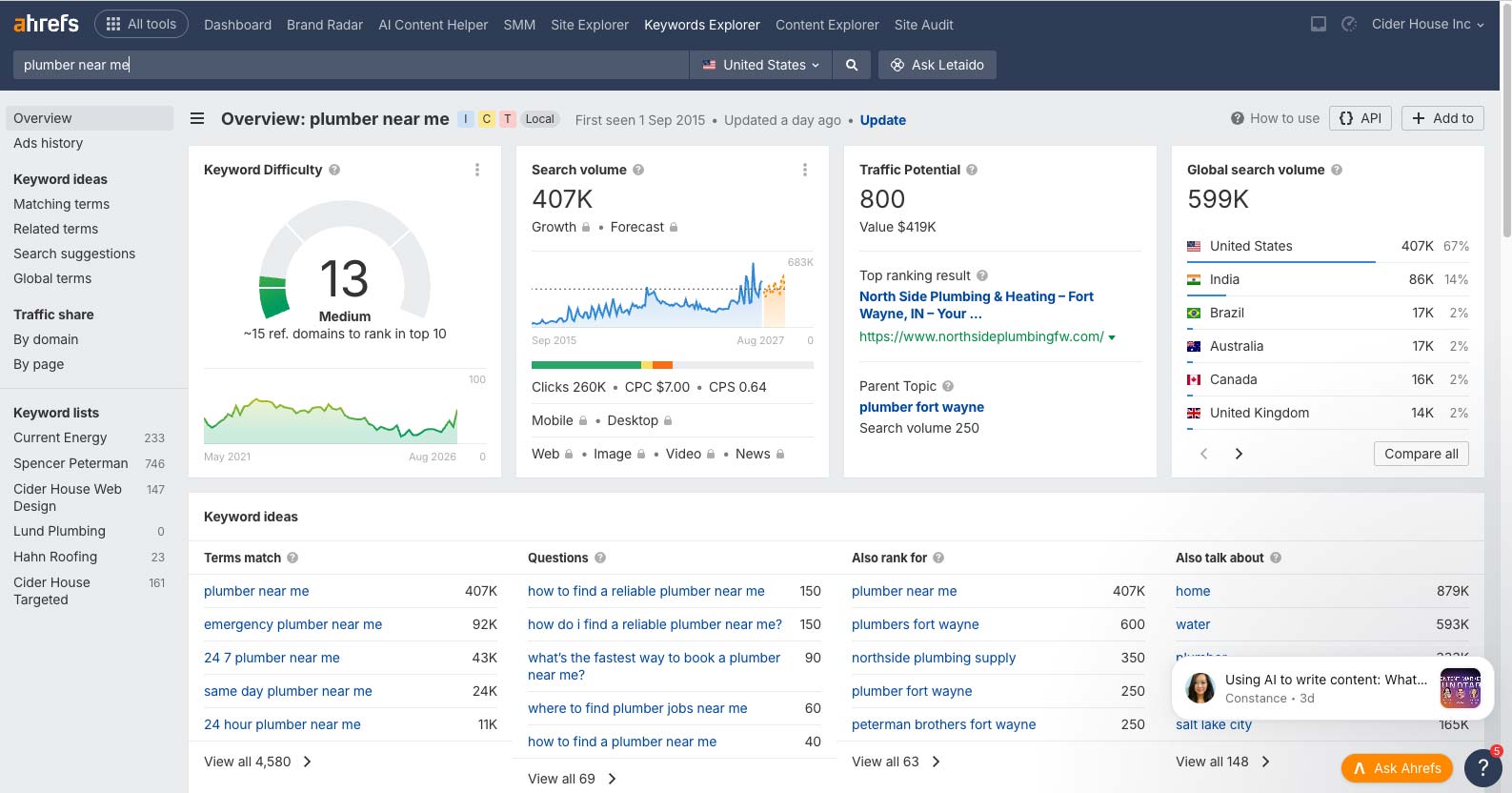
Keyword research shows the scale and variety of local plumbing searches, from “plumber near me” to emergency and same-day searches.
How to actually do keyword research, and the tools that help
You can guess at keywords, or you can look them up. Looking them up wins nearly every time.
Start free. Type the beginning of a search into Google and watch what Autocomplete suggests. Those suggestions are real queries other people are running. Then scroll to the bottom of the results page and read the “related searches.” That’s a list of what else your customers type, pulled straight from the source, and it costs you nothing.
When you want harder numbers, a keyword research tool shows you search volume and how tough a term is to rank for. Google’s own Keyword Planner is free and fine to start with. Paid tools like Ahrefs or Semrush go deeper if you decide to invest. What you’re hunting for is the sweet spot. Enough people searching a term to make it worth a page, without every national plumbing chain already fighting over the top spot.
Spend real attention on long-tail keywords. “Plumber” alone is a brawl you probably won’t win. “Emergency water heater repair in [city]” is a phrase a ready-to-book homeowner types, and far fewer sites bother to target it. Those longer, specific searches convert better and rank easier. Build pages and posts around them on purpose.
Using emergencies and common plumbing questions to inspire content
Plumbing demand isn’t weather-driven the way roofing is, but it still has its spikes. A hard freeze sends burst-pipe searches through the roof. The days after Thanksgiving? Garbage disposals and clogged drains, every single year. Heavy rain pulls in sump-pump and sewer-backup calls. Your own search data will show you the pattern for your market.
Capture those. Every tech fields the same questions on repeat. Why is my water bill suddenly high? Should I repair the water heater or replace it? What’s the black gunk in my drain? Each one is a blog post or an FAQ waiting to happen. A lot of them start with “how to” or “what is,” which are exactly the informational searches you want to catch early. They pull in searchers before they’re ready to call, and they back up your main service pages.
On-Page SEO for Your Plumbing Website
On-page SEO is everything you control on the page itself. It’s how you tell Google what a page is about. For you, that means making it obvious when a page covers drain cleaning versus water heater service versus emergency work in a specific town. No guessing.
This isn’t about cramming keywords everywhere. It’s about giving each page one job. One clear topic, stated plainly in the title and the headings, so a person and a search engine reach the same conclusion within a few seconds.
Optimizing title tags, meta descriptions, and headings for plumber SEO
Your title tag is what shows up as the blue clickable headline in the search results, and it pulls double duty on ranking and clicks. Keep it under about 60 characters so Google doesn’t cut it off, and put your keyword and your town in it. Something as plain as “Emergency Plumber in [City] | 24 Hour Plumbing Repair” tells Google what the page is and tells a panicked homeowner they’ve landed in the right place.
Your meta description is the gray text underneath. Google doesn’t rank on it directly, but it’s your pitch for the click. Keep it under roughly 120 characters so it survives on a phone screen, give a real reason to pick you, and end with a nudge like “Call now for same-day service.” A sharper meta description lifts your click-through rate even when your ranking hasn’t budged.
Use your H2s and H3s to break the page into chunks a skimmer can follow. What the service is. The problems it fixes. What the visit looks like. A couple of common questions. Work your keywords in where they read naturally, and nowhere they don’t. Forced repetition reads worse to a homeowner than it ever helps you with Google.
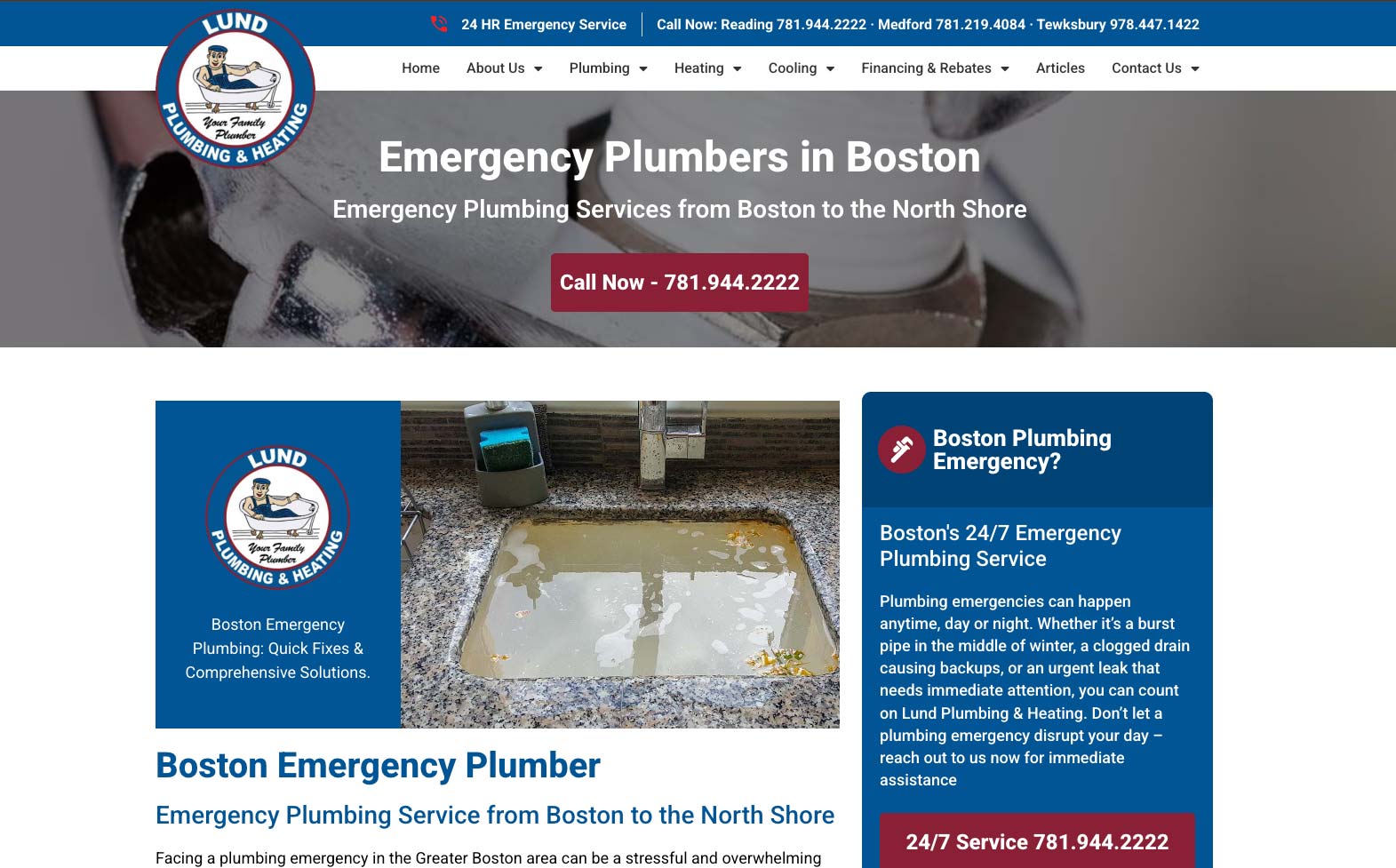
A strong service page makes the service, location and next step immediately clear—especially for high-intent searches like emergency plumbing.
Creating each plumbing page around one main keyword
One page, one idea. That single rule keeps a lot of sites out of trouble. A “services” page trying to rank for everything ranks for nothing. Give drain cleaning its own page. Give water heaters their own. Do the same for sewer repair, emergency work, and each town you want to own.
Each page picks one main keyword and explains that one service the way a homeowner thinks about it. When somebody searches for that exact thing, Google has a clean match to hand them. It doesn’t have to guess which of your pages is closest.
On-page SEO best practices for plumbing contractors
You don’t have to be a professional to get the basics down. Use clean URLs with your keyword in them, not strings of random numbers. Add real alt text to your photos, like “new tankless water heater install in [city],” so Google knows what it’s looking at. And link between related pages when it genuinely helps the reader. That’s how search engines learn how your content fits together.
Above all, keep the writing human. Explain things the way you would at someone’s kitchen table, clipboard in hand, working up an estimate. The keywords can be there without you sounding like a robot reading a script. Useful copy that happens to carry the right terms is what turns any of this from theory into booked work.
A quick note if you also run HVAC. You’re in good company. Plenty of searches pair the two trades together. Decide up front whether HVAC gets its own pages and its own guide, or sits as a section under plumbing. Just don’t let one page try to rank for both. It’ll do neither well.
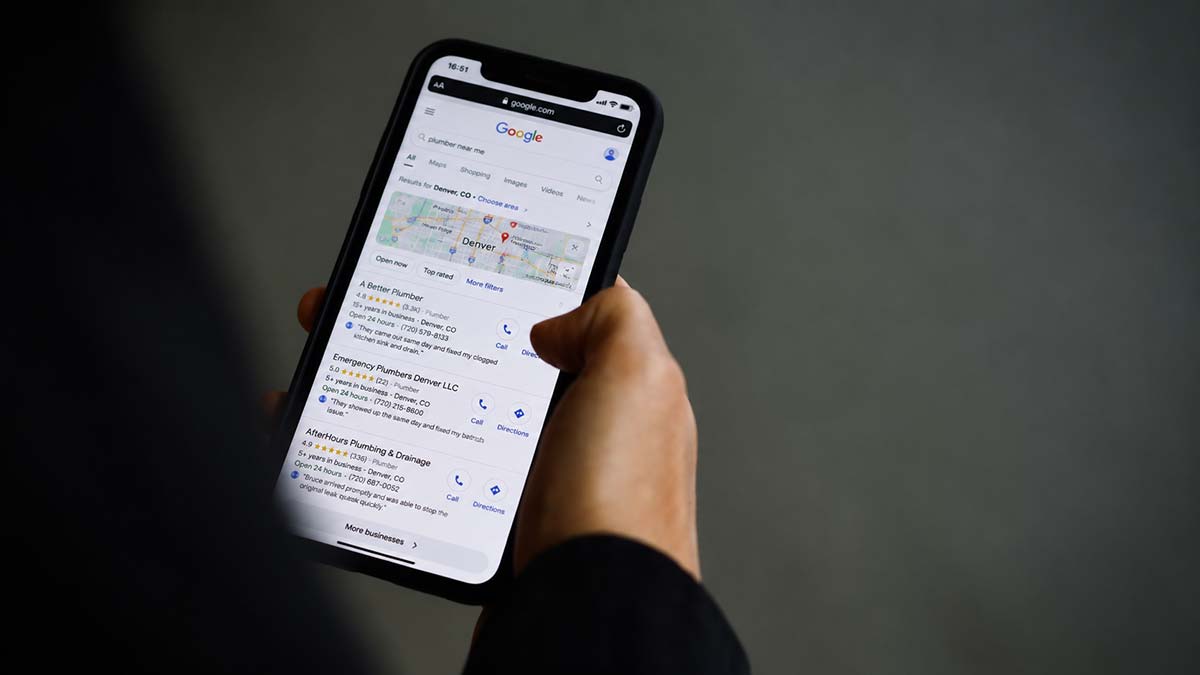
For searches like “plumber near me,” Google’s Map Pack puts local plumbing companies, reviews, hours, and contact options directly in front of mobile searchers.
Local SEO for Plumbers and Plumbing Companies
Nearly all your work comes from a set radius around the shop. Local SEO is how you make sure you show up inside that radius and not outside it. Nobody in another state is going to hire you. This is about owning the searches in the towns you actually drive to.
Three things carry most of the weight. Your Google Business Profile. Your listings across the rest of the web, and whether they match. And your reviews.
What the local pack is, and how Google decides who’s in it
The local pack is that box of three businesses with the little map, sitting at the top of local results. For a lot of plumbing searches it lands above everything else on the page, so getting in is worth real effort. Google weighs three things to fill those spots. How close you are to the person searching. How well your profile and site match what they typed. And how well-known you are, measured mostly through reviews and citations. You can’t do much about proximity
. But relevance and reputation are yours to win, and winning them is usually enough to crack the three.
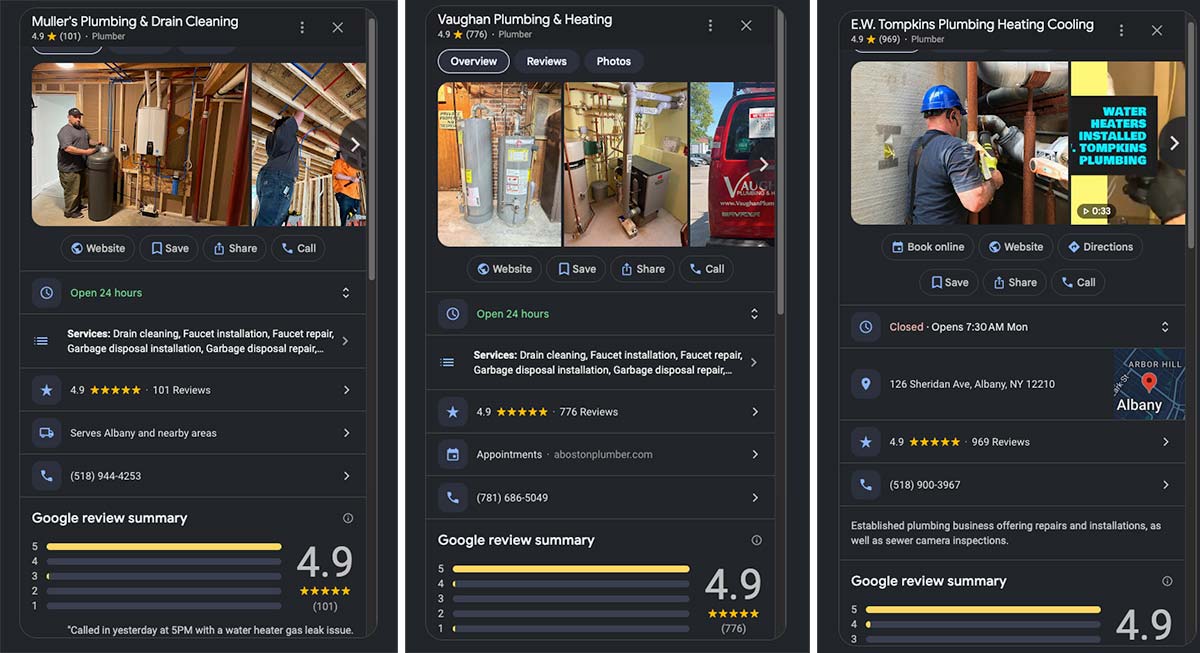
Strong plumbing profiles give customers—and Google—more information about services, reputation, availability and the business itself.
Setting up and optimizing your Google Business Profile for plumber SEO
Your Google Business Profile, which a lot of people still call Google My Business, is the single most valuable thing you own in local search. Claim it and verify it if you haven’t. Then fill out every field they give you. Use your real business name. Pick the plumbing categories that actually fit. Add the address and the number you answer in person.
Now add photos, and not stock ones. Your crew. Your trucks. A before-and-after of a drain job, a fresh water heater install. Write a description that names your main services and towns without reading like a keyword dump. Post the occasional update, especially around a cold snap when the calls jump. A profile you actually tend becomes a source of calls, not a box you ticked once back in 2019.
If you run emergency service, get your hours exactly right. Setting “open 24 hours” correctly is the whole difference between catching that 2 a.m. burst-pipe call and watching it go to the next listing down.
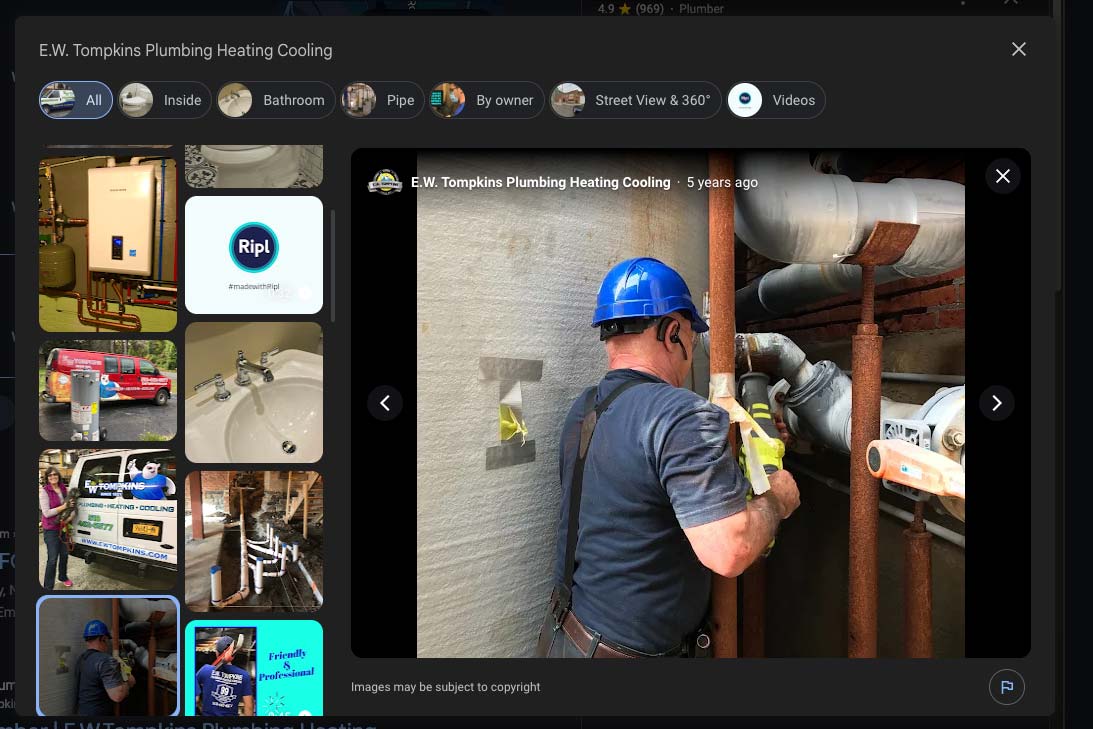
Real project and team photos help turn a Google Business Profile into something prospective customers can actually evaluate.
Local citations, NAP consistency, and appearing across the web
“Across the web” sounds vague, but it’s straightforward. Your business should show up in the local directories and service sites people trust, and the details need to match everywhere they appear. Same name, same address, same phone. When one listing has an old address and another has a number you dropped two years ago, Google gets mixed signals and hedges its bets on you.
Set aside an afternoon to claim or fix your listings on the bigger platforms. It’s tedious work, no way around it. But consistent citations tell Google you’re a real local business with a real address, not a lead-reseller running a front.
Getting reviews that boost local search visibility
Reviews are usually the tie-breaker when someone’s choosing between two plumbers. Trust matters more here than in most trades. You’re asking to come into somebody’s home, often while they’re already stressed and out a fair bit of money. So people read the recent reviews, glance at the star rating, and watch how you answer the unhappy ones. Google runs a version of the same read at scale, and reviews feed straight into whether you land in that local pack.

Reviews do more than build a star rating. Specific feedback about responsiveness, professionalism, pricing, and quality helps prospective customers decide which plumber they can trust.
Build the ask into your process instead of leaving it to memory. Job goes well, text the customer a review link that same day, while they still remember how relieved they were. Those reviews stack up over months. They name your techs, mention your response time, note whether the price matched the quote. That’s exactly what nudges you up the local pack and helps you close the next caller.
Content Marketing and Blogging for Plumber SEO
Your service pages carry the core keywords, but they’re only half the picture. A big share of plumbing searches are just questions. People want to understand what’s wrong before they hand money to a stranger. Content marketing lets you catch them at that earlier moment.
The content that works answers a real question in the same words a homeowner would use to ask it. Do that, and it supports the rest of your SEO quietly, without ever reading like an ad.
Answering common plumbing questions homeowners search for
Your techs and your front desk answer the same handful of questions every single week. Those are your blog posts, already written in your customers’ language. Should I repair the water heater or replace it? Why does this drain keep clogging? What’s making the pressure drop all over the house? Is a running toilet really worth a call?
Answer each one in a short, plain article and two things happen. You pull in searchers early, and you earn a little trust before the phone rings. You’re also showing Google your site covers plumbing in real depth, which lifts your service pages right along with it.
Blog post ideas that support your plumber SEO campaign
A few ideas you can turn into posts that align with your keywords:
- “Water Heater Repair vs. Replacement: How to Decide (and What It Costs)”
- “7 Signs You Have a Hidden Water Leak in [Region]”
- “What to Do the Moment a Pipe Bursts, Before the Plumber Arrives”
- “Why Your Drains Keep Clogging (and How to Stop It for Good)”
- “Tankless vs. Tank Water Heaters: Which Is Right for Your Home?”
Each piece can target a specific keyword and link back to a relevant service page. That internal linking helps Google map your site and strengthens your overall SEO.
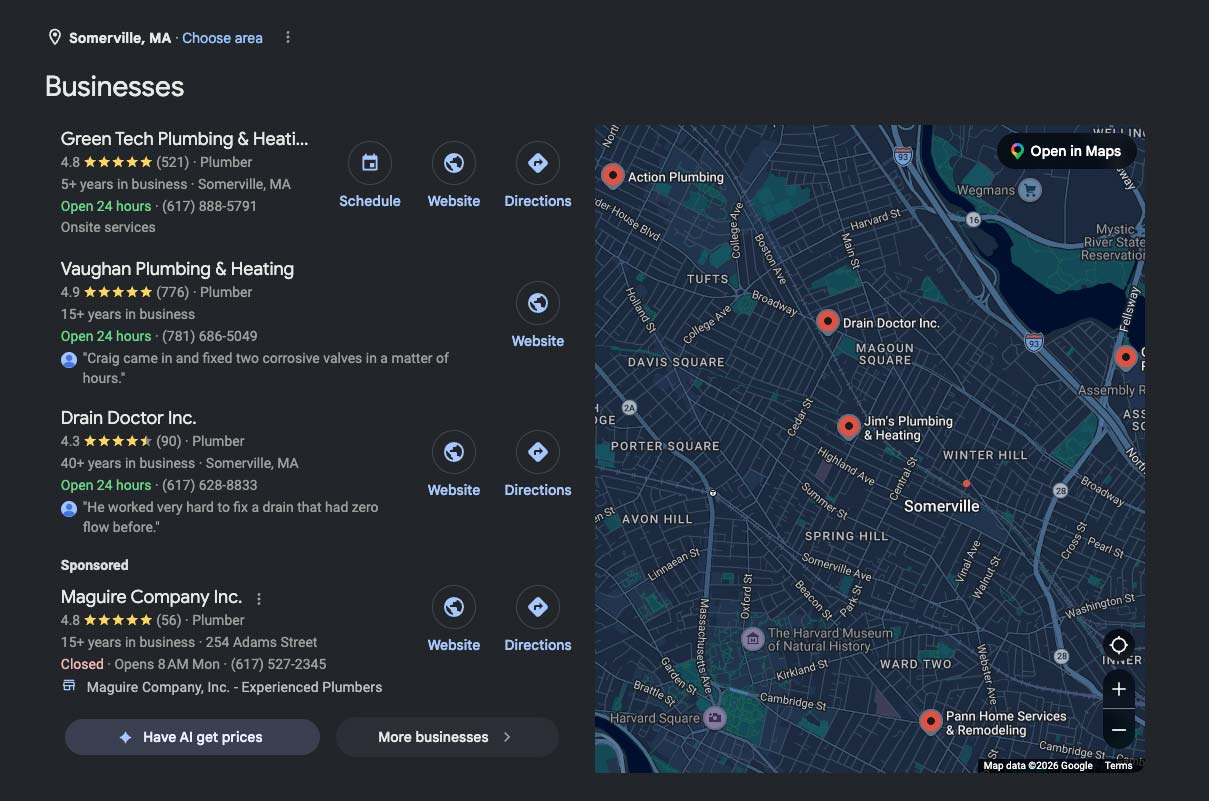
Local plumbing results change with geography. Google uses the searcher’s location along with relevance and prominence to determine which businesses appear.
Using location and service pages to target local plumbing customers
Beyond blogs, build real location and service pages for the areas you care about most. A “Plumber in [City]” page can name actual neighborhoods, mention what’s common in that housing stock, whether that’s hard water or pipes from the 1950s, and show photos of jobs you did a few streets over. A “Commercial Plumbing in [City]” page speaks a different language entirely, the one property managers use. Backflow testing. Code. Scheduled maintenance.
Whatever the page, give it the pieces that actually turn a visitor into a call:
- A headline that names the service and the town, so there’s no doubt they’re in the right place
- A few bullets on why you, not the other three plumbers they’re comparing
- A contact form and a tap-to-call number high on the page, before anyone has to scroll
- One clear action, like “Get a free estimate” or “Book same-day service”
- A trust signal or two, like a license number, years in business, or a review count
This is something we pay close attention to at Cider House Media. A location page shouldn’t exist just to give Google another city name to index. It needs to be useful to someone who actually lives there, while giving search engines enough real local context to understand where you work and what you do.
Technical SEO and User Experience for Plumbing Websites
Technical SEO never comes up in a sales meeting, but for plumbers it might matter more than most trades. A homeowner in a panic won’t wait on a slow page or fight with a form that’s broken on their phone. They’ll hit back and call the next name on the list. Google watches that happen and quietly moves you down.
Want to see how your site performs? Run it through Google’s free PageSpeed Insights tool to check speed, Core Web Vitals, accessibility, and other performance issues.
You don’t have to chase every metric in the report. Focus on what a real person feels during an emergency. Does the page load fast? Does it work with one thumb? Can they find the phone number without scrolling three times? Get those right and the rest matters a lot less.
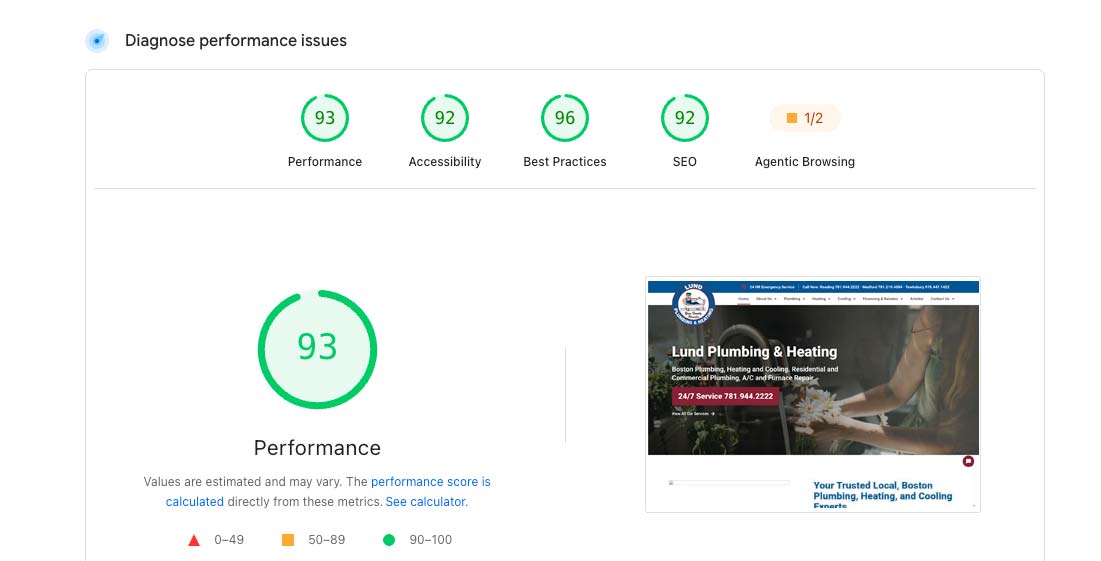
Site speed is part of technical SEO. This plumbing website scores 93 for performance in Google PageSpeed Insights.
Site speed, mobile optimization, and Core Web Vitals for plumbing sites
Most emergency searches happen on a phone, one hand, while the other one’s holding a towel against the leak. If your site isn’t built for that moment, they’re gone. Compress the big images. Cut the plugins you don’t use. Pay for a host that doesn’t choke when a page loads.
We’ve built and optimized websites for local and home-service businesses, and one thing is consistent: getting the click is only half the job. The website still has to make it incredibly easy for someone to understand what you do, trust you, and get in touch, especially on a phone.
Make the phone number tap-to-call. Test your forms on an actual phone, not just your desktop. Keep the layout from jumping around while it loads. That’s what Core Web Vitals really means once you strip the jargon off it. It helps your ranking, yes. But for a plumber, a working tap-to-call button is often the thing that decides who wins the job.
Technical SEO basics to help search engines crawl your plumbing website
Give Google a clear path through the site. Keep the menu simple and don’t bury your service pages three clicks down. Build an XML sitemap with your main service and location pages on it, then submit it in Search Console so the crawlers actually find everything.
Fix the broken links. Clear out the thin, half-finished pages and any duplicates. Make sure the whole site runs on HTTPS. If you want a fuller picture of what’s holding the site back, run an SEO audit and work down the list it gives you. None of this is as satisfying as publishing a new post, but skip it and it quietly caps everything else you’re doing.
Link Building and Online Authority for Plumbing Companies
Links still count, and in SEO they usually go by the name backlinks. For a plumber, building them just means getting other real sites to point at yours. Each backlink works like a reference, a small vote telling Google you’re an actual business worth ranking.
You don’t need a full-time link builder or any of the sketchy tactics that get sites penalized. A handful of honest moves does the job. Local mentions. A few industry sites. The odd partnership. Nothing that feels like a stunt.
How local links and mentions improve your plumber SEO
Local backlinks carry real weight. A link from the chamber of commerce, the local paper, or a supplier you buy from tells Google you’re woven into the community. It counts for even more when the mention names your city or the work you do.
Think about where your name already belongs, or could. The Little League team you sponsor. A charity drive you pitch in on every fall. The partner page on your supply house’s website. The GCs and HVAC shops who send work your way. Some of those turn into links. When they do, they nudge your local rankings up without you ever buying a thing.
Getting listed on industry directories and home-service platforms
Get yourself onto the directories and home-service platforms homeowners actually check. Plenty of them rank for broad plumbing terms on their own, so they can send you leads directly while they add to your backlink profile.
Fill each profile out all the way. List your services and the areas you cover. Mention how long you’ve been at it, and any license or certification worth showing off. Link back to your site, and keep every detail matching the last one. Together, all these mentions add up under your SEO.
A Few Things That’ll Set Your Plumber SEO Back
Most of SEO is doing the right things patiently. But a few shortcuts actively hurt, and they’re worth naming so you don’t waste money chasing them.
Don’t buy backlinks. It looks like a fast way to build authority, and Google has gotten good at spotting it. Bought links get sites penalized, and digging out from a penalty costs far more than the links ever saved you.
Don’t stuff keywords. Writing “emergency plumber [city]” eleven times in one paragraph won’t lift your ranking. It reads badly to the homeowner, and Google treats it as a spam signal. Use the term where it fits and move on.
Don’t run thin or duplicate pages. Spinning up twenty near-identical city pages with only the town name swapped is tempting when you’re trying to scale, but Google sees through it, and so do customers. One genuinely useful page beats ten copies of a hollow one. Write each page like it’s the only one you’ve got.
Tracking Plumber SEO Results and Improving Over Time
SEO isn’t a one-and-done job. It’s closer to maintenance than a single repair. You make a round of changes, then come back later to see what moved, what didn’t, and what needs another pass.
The questions worth asking are plain ones. Are we ranking higher than last quarter? Is more traffic coming in from search? And the one that actually pays the bills: are those visits turning into booked jobs?

A strong plumbing website has to do more than rank. Once someone lands on the site, it needs to quickly communicate services, build trust, and make it easy to get in touch.
Measuring rankings, leads, and website traffic for plumber SEO
A few free tools cover most of what you need. Google Search Console shows which searches you already turn up for and roughly where you sit. Google Analytics shows what people do once they land on the site. If you want competitor context or closer rank tracking, a paid tool like Ahrefs or Semrush fills that in. You don’t need all of them on day one. Search Console alone tells you more than most plumbers ever bother to look at.
Watch the keywords that matter, like “emergency plumber near me” and “water heater repair [city],” and note where you rank for each. But rankings are a starting point, not the finish line. Track how many calls and form fills come from organic search, and tie them back to real revenue if you can. Once you see which pages and keywords bring actual jobs, you know exactly where to spend your next hour.
Adjusting your plumber SEO strategy based on data
With real numbers in front of you, it beats guessing every time. A page pulling traffic but no calls usually needs a clearer offer or a next step you can’t miss. A blog post quietly bringing in visitors is worth expanding, with a stronger link over to the service page it supports.
Publish, measure, adjust, repeat. That loop is what real SEO looks like over the span of a year. You’re not chasing keywords once and hoping. You’re staying in it, keeping the rankings climbing instead of drifting back down.
When to Hire a Plumber SEO Company or Agency
Most plumbing owners hit a wall at some point. They get why SEO matters. They’ve made a few changes that helped. But they’ve got no interest in spending their evenings writing pages and refreshing rank trackers. That’s usually the moment a plumber SEO company earns its keep.
The point isn’t to hand off your whole business. It’s to bring in someone who knows plumbing marketing and local search well enough to carry the SEO forward while you stay focused on the actual plumbing.
What to look for in plumber SEO services and agencies
A good plumber SEO partner won’t hide behind jargon. They’ll explain what they’d actually do to your site and why, in plain terms. And they’ll show you real work for other home-service companies, with the results those clients saw, not vague promises about page one.
Ask how they pick keywords, what they actually deliver each month, and how they report on it. You want someone playing a long game, not chasing quick tricks that get you penalized six months later. When you find that person, paying for SEO stops feeling like a gamble and starts feeling like hiring a good sub you trust.
Questions to ask a plumber SEO expert before you invest
Before you sign anything, put a few direct questions on the table. How will you choose our keywords for this market? What’s the plan for our site structure and content? How will you handle our Google Business Profile and reviews? And how will we know, in plain numbers, whether it’s working?
Listen for straight answers, not buzzwords. The right partner talks in outcomes you can feel. More calls. More jobs on the schedule. Your name at the top when someone nearby needs a plumber. That’s the difference between being visible and being the one who actually gets the call.
SEO for Plumbing Companies
At Cider House Media, we help home-service businesses build stronger visibility in local search. Our SEO programs combine technical SEO, local search strategy, service and location content, Google Business Profile optimization, and ongoing measurement to build a search presence that grows over time.
If you’re looking for an SEO partner to help your plumbing company compete in your local market, we’d be happy to talk.
